b2b saas
b2b saas
finance
finance
Enterprise Automated Revenue Reconciliation
for Multi-Gateway SaaS
Enterprise Automated Revenue Reconciliation
for Multi-Gateway SaaS
Enterprise Automated Revenue Reconciliation
for Multi-Gateway SaaS
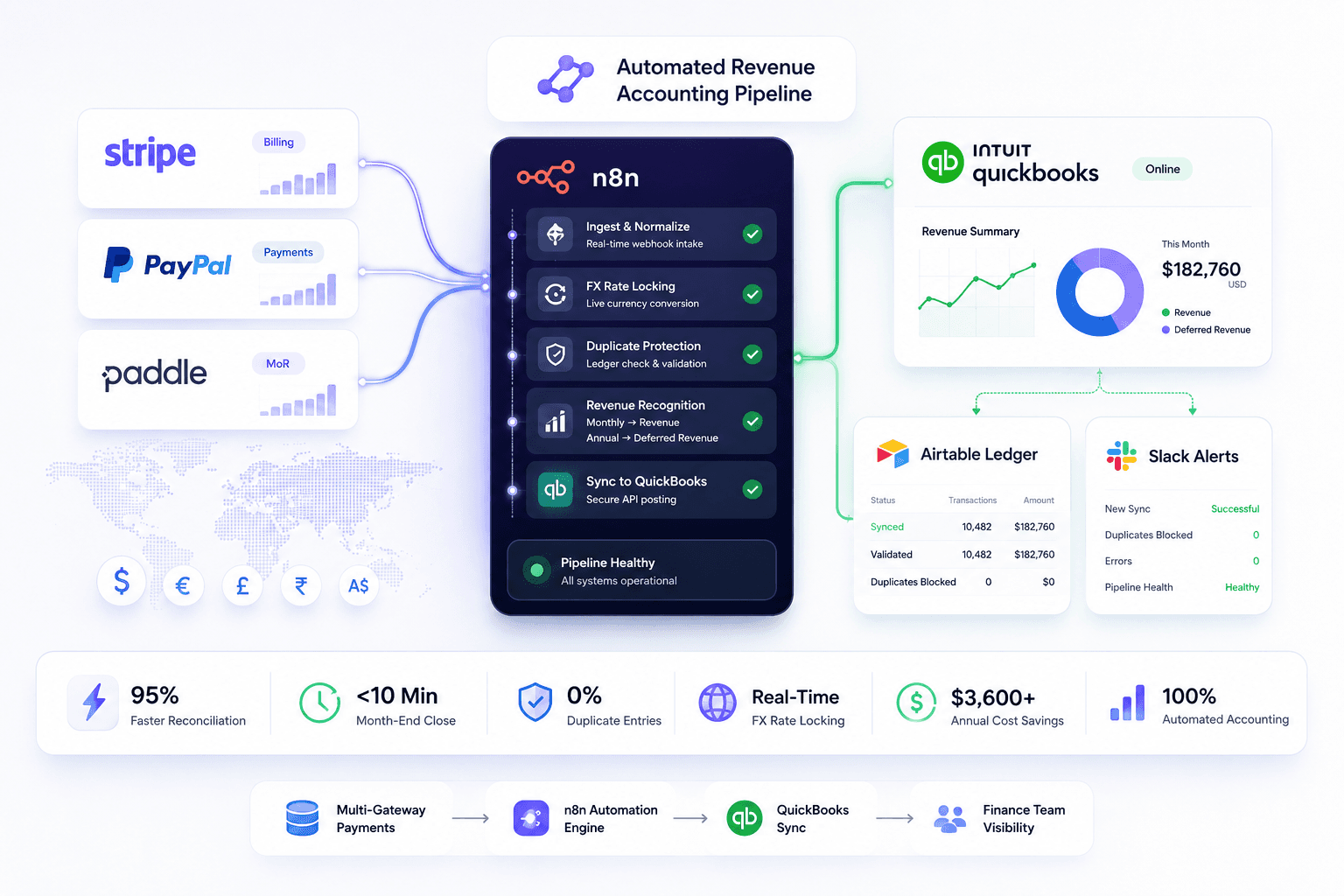
A custom financial automation system developed for a SaaS business to automate transaction reconciliation, currency handling, accounting workflows, duplicate prevention, and financial visibility across multiple payment platforms.
A custom financial automation system developed for a SaaS business to automate transaction reconciliation, currency handling, accounting workflows, duplicate prevention, and financial visibility across multiple payment platforms.
A custom financial automation system developed for a SaaS business to automate transaction reconciliation, currency handling, accounting workflows, duplicate prevention, and financial visibility across multiple payment platforms.
Role
AI Automation Engineer / Technical Contributor
Environment:
Private client infrastructure
Stack
n8n Enterprise, Stripe, PayPal, Paddle
QuickBooks, Airtable, Slack
I joined an existing team working on the system and contributed across requirements analysis, technical research, validation, workflow design, and implementation.
I joined an existing team working on the system and contributed across requirements analysis, technical research, validation, workflow design, and implementation.
I joined an existing team working on the system and contributed across requirements analysis, technical research, validation, workflow design, and implementation.
THE BUSINESS PROBLEM
THE BUSINESS PROBLEM
As a subscription SaaS scales globally, manual revenue reconciliation becomes a multi-headed nightmare. Our client, a high-volume B2B SaaS processing over 5,000+ monthly subscriptions across Stripe, PayPal, and Paddle, faced severe financial bottlenecks:
The Accrual Split Nightmare: Standard native integrations fail to distinguish between Monthly and Annual contracts. Annual upfront payments were being recognized immediately instead of being split into Deferred Revenue Liabilities, violating GAAP compliance.
Multi-Currency Chaos: Global users paid in EUR, GBP, and INR, causing extreme discrepancies during reconciliation due to delayed or inaccurate historical exchange rates.
App Fatigue & High Monthly Tolls: Third-party connector tools (like Synder) charged crippling transaction-volume fees, costing thousands per year while offering zero pipeline customization or fault tolerance.
The main operational problems were:• 40+ hours of manual financial data entry per month
• 4 to 5 business days required for financial closing
• Different data structures across payment platforms
• Manual refund and reconciliation workflows
• Duplicate transaction risk
• Limited visibility into processing failures
As a subscription SaaS scales globally, manual revenue reconciliation becomes a multi-headed nightmare. Our client, a high-volume B2B SaaS processing over 5,000+ monthly subscriptions across Stripe, PayPal, and Paddle, faced severe financial bottlenecks:
The Accrual Split Nightmare: Standard native integrations fail to distinguish between Monthly and Annual contracts. Annual upfront payments were being recognized immediately instead of being split into Deferred Revenue Liabilities, violating GAAP compliance.
Multi-Currency Chaos: Global users paid in EUR, GBP, and INR, causing extreme discrepancies during reconciliation due to delayed or inaccurate historical exchange rates.
App Fatigue & High Monthly Tolls: Third-party connector tools (like Synder) charged crippling transaction-volume fees, costing thousands per year while offering zero pipeline customization or fault tolerance.
The main operational problems were:• 40+ hours of manual financial data entry per month
• 4 to 5 business days required for financial closing
• Different data structures across payment platforms
• Manual refund and reconciliation workflows
• Duplicate transaction risk
• Limited visibility into processing failures
MY APPROACH
MY APPROACH
I first worked with the existing team to finalize the actual requirements and understand how the financial process worked in practice. For the QuickBooks integration, I worked alongside the client's finance experts to understand the accounting requirements before implementing the workflow.
I also studied existing platforms offering similar financial integrations to SaaS businesses. Their workflows helped identify where third party solutions created limitations around control and customization. Those findings helped shape a custom workflow that kept the required business logic within the client's own infrastructure.
I first worked with the existing team to finalize the actual requirements and understand how the financial process worked in practice. For the QuickBooks integration, I worked alongside the client's finance experts to understand the accounting requirements before implementing the workflow.
I also studied existing platforms offering similar financial integrations to SaaS businesses. Their workflows helped identify where third party solutions created limitations around control and customization. Those findings helped shape a custom workflow that kept the required business logic within the client's own infrastructure.
SYSTEM ARCHITECTURE
SYSTEM ARCHITECTURE
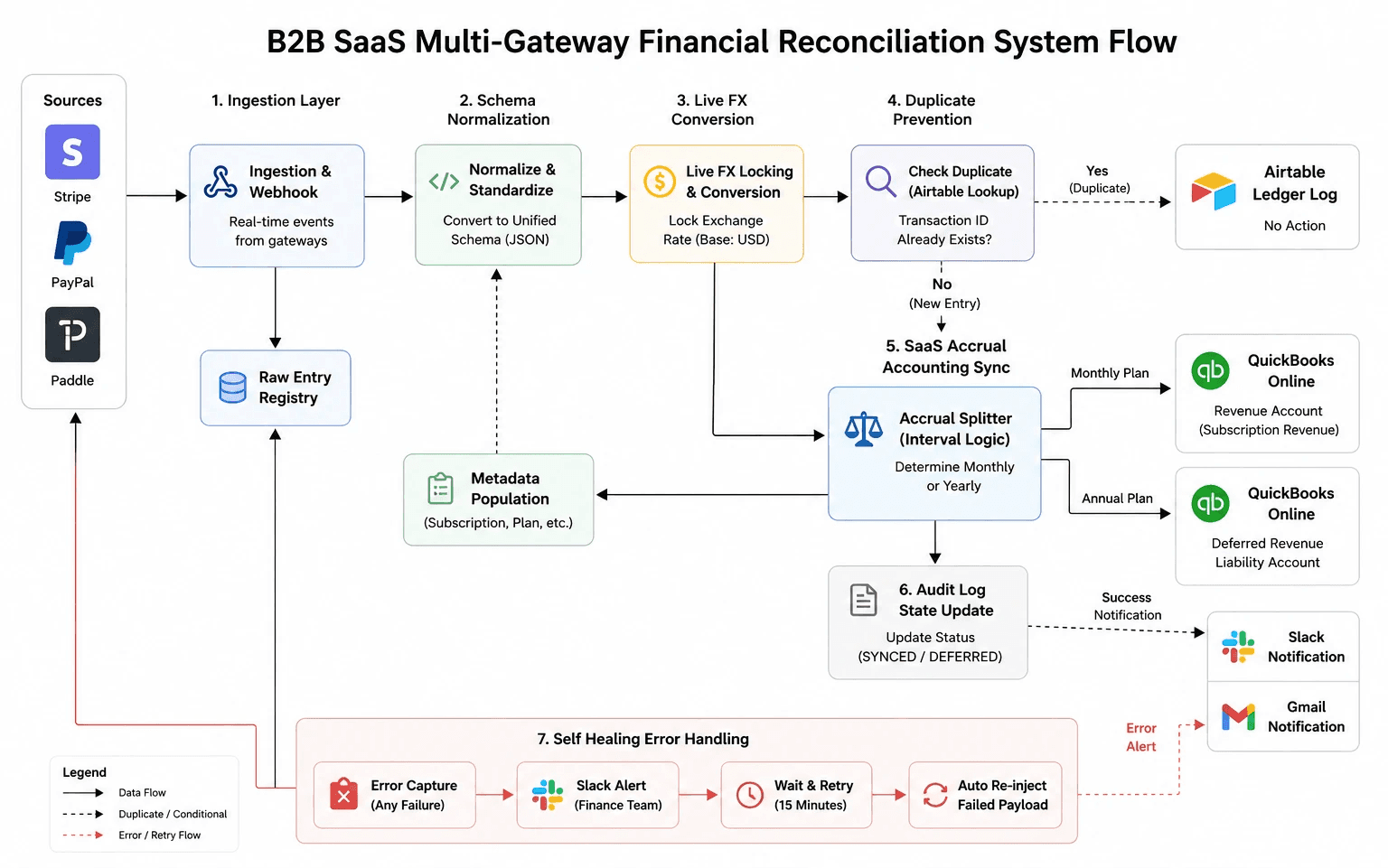
The pipeline acts as a bulletproof financial translator, normalizing mixed API streams into a single source of truth.
Here is how the automated workflow safely processes data:
The pipeline acts as a bulletproof financial translator, normalizing mixed API streams into a single source of truth.
Here is how the automated workflow safely processes data:
ENGINEERING & KEY DECISIONS
ENGINEERING & KEY DECISIONS
Custom Workflow
Instead of depending entirely on an external reconciliation platform, the team implemented the required financial logic in a custom workflow. This provided greater control over integrations, business rules, and data handling.
Private Infrastructure
n8n was deployed on the client's private server to maintain control over the automation environment and financial data processing.
Standardized Transactions
Stripe, PayPal, and Shopify data were converted into a common structure before reconciliation. This reduced platform specific logic throughout the accounting workflow.
Accounting First
QuickBooks behavior was designed around the client's actual finance requirements rather than treating accounting synchronization as a simple API connection.
Custom Workflow
Instead of depending entirely on an external reconciliation platform, the team implemented the required financial logic in a custom workflow. This provided greater control over integrations, business rules, and data handling.
Private Infrastructure
n8n was deployed on the client's private server to maintain control over the automation environment and financial data processing.
Standardized Transactions
Stripe, PayPal, and Shopify data were converted into a common structure before reconciliation. This reduced platform specific logic throughout the accounting workflow.
Accounting First
QuickBooks behavior was designed around the client's actual finance requirements rather than treating accounting synchronization as a simple API connection.
VALIDATION & REAL WORLD BEHAVIOR
VALIDATION & REAL WORLD BEHAVIOR
The workflow was validated against the requirements and transaction scenarios identified during the project.
Testing covered:
• Transaction normalization
• Duplicate detection
• Currency conversion
• Payment and refund processing
• QuickBooks synchronization
• Audit records
• Workflow failures and retry handling
The system was implemented in the client's private environment. Ongoing maintenance is handled by the wider team.
The workflow was validated against the requirements and transaction scenarios identified during the project.
Testing covered:
• Transaction normalization
• Duplicate detection
• Currency conversion
• Payment and refund processing
• QuickBooks synchronization
• Audit records
• Workflow failures and retry handling
The system was implemented in the client's private environment. Ongoing maintenance is handled by the wider team.
RESULTS & EVIDENCE
RESULTS & EVIDENCE
REPLACING MANUAL RECONCILIATION WITH A CONTROLLED FINANCIAL PIPELINE.
<10 MIN / MONTH-END RECONCILIATION
Reduced reconciliation processing from approximately 7 business days to less than 10 minutes.
100% / AUTOMATED BOOKKEEPING COVERAGE
Automated the defined transaction-processing and bookkeeping workflow across the connected payment sources.
0% / DUPLICATE LEDGER ENTRIES
Eliminated duplicate ledger entries within the implemented reconciliation workflow.
REAL-TIME / FINANCIAL VISIBILITY
Moved transaction visibility from delayed manual reconciliation toward continuously updated operational records.
$3,600+ / ANNUAL APP COST AVOIDANCE
Reduced reliance on third-party reconciliation tooling through the custom automation layer.
100% / TRANSACTION COVERAGE
Designed the pipeline to process the defined payment transaction flow rather than relying on selective manual reconciliation.
REPLACING MANUAL RECONCILIATION WITH A CONTROLLED FINANCIAL PIPELINE.
<10 MIN / MONTH-END RECONCILIATION
Reduced reconciliation processing from approximately 7 business days to less than 10 minutes.
100% / AUTOMATED BOOKKEEPING COVERAGE
Automated the defined transaction-processing and bookkeeping workflow across the connected payment sources.
0% / DUPLICATE LEDGER ENTRIES
Eliminated duplicate ledger entries within the implemented reconciliation workflow.
REAL-TIME / FINANCIAL VISIBILITY
Moved transaction visibility from delayed manual reconciliation toward continuously updated operational records.
$3,600+ / ANNUAL APP COST AVOIDANCE
Reduced reliance on third-party reconciliation tooling through the custom automation layer.
100% / TRANSACTION COVERAGE
Designed the pipeline to process the defined payment transaction flow rather than relying on selective manual reconciliation.
LESSONS & LIMITATIONS
LESSONS & LIMITATIONS
The project showed that financial automation requires a clear understanding of accounting requirements before implementation. Working with the client’s finance experts helped translate real accounting processes into reliable system rules.
A key limitation was that the system depended on multiple external platforms and APIs, so changes in third party integrations could affect the workflow. The custom architecture and centralized processing reduced this dependency at the business logic level while keeping the system under the client’s infrastructure control.
The project showed that financial automation requires a clear understanding of accounting requirements before implementation. Working with the client’s finance experts helped translate real accounting processes into reliable system rules.
A key limitation was that the system depended on multiple external platforms and APIs, so changes in third party integrations could affect the workflow. The custom architecture and centralized processing reduced this dependency at the business logic level while keeping the system under the client’s infrastructure control.
Role
AI Automation Engineer / Technical Contributor
Environment:
Retail / Boutiques
Private client infrastructure
Stack
n8n Enterprise, Stripe, PayPal, Paddle
QuickBooks, Airtable, Slack
ENGINEERING DECISIONS
BUILT FOR FINANCIAL ACCURACY. NOT JUST AUTOMATION.
BUILT FOR FINANCIAL ACCURACY. NOT JUST AUTOMATION.
Financial automation has little value if the underlying records cannot be trusted. This section breaks down the architectural decisions behind transaction integrity, reconciliation logic, failure handling and exception control.
Financial automation has little value if the underlying records cannot be trusted. This section breaks down the architectural decisions behind transaction integrity, reconciliation logic, failure handling and exception control.
How did you ensure a transaction could not be reconciled twice?
What happens if the payment gateway succeeds but the accounting update fails?
How did you handle three payment gateways with different data models?
How did you know the automated reconciliation was financially correct?
What happens when the data from the payment gateway doesn't match the accounting record?