


Overview
Operational Systems coordinate how work moves through an organization. We design the workflows, events, decisions, human responsibilities, system actions, and feedback loops that turn fragmented operations into a visible and controllable execution system.
The objective is not simply to automate more tasks. It is to make operations easier to execute, observe, recover, and improve — while keeping people involved where judgment, accountability, or exception handling still matters.
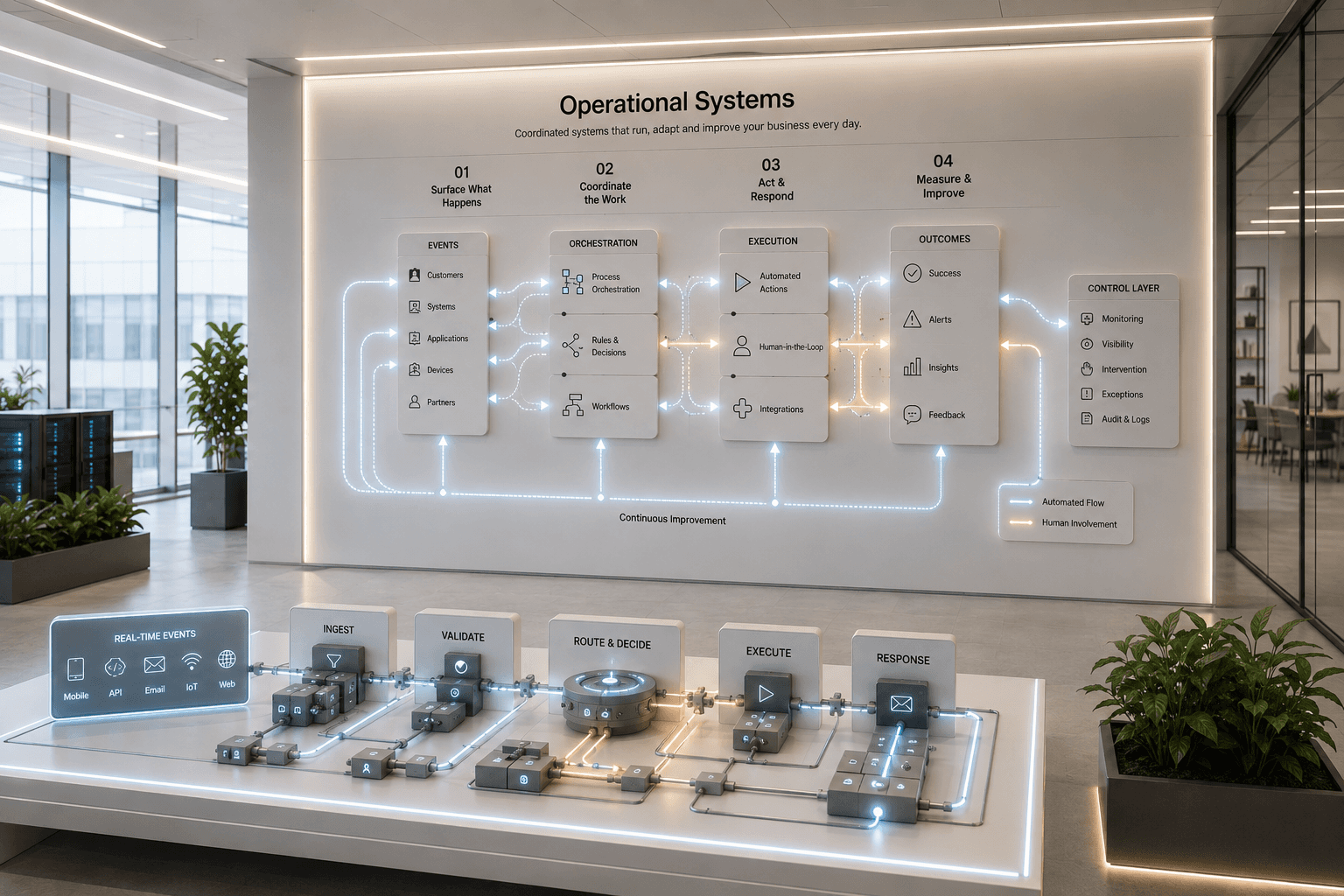
How Operational Systems Work
Strong operations continuously sense what is happening, coordinate what should happen next, execute across people and systems, and turn the resulting signals back into better decisions.
Sense What Happens
01
Capture events, requests, state changes, exceptions, metrics, and human inputs from across the operating environment.
Coordinate the Work
02
Route tasks, systems, approvals, services, and people through the right sequence based on process state and business rules.
Act & Respond
03
Trigger software actions, human tasks, decisions, notifications, remediation, and downstream workflows as conditions change.
Measure & Improve
04
Observe throughput, delays, failures, deviations, and outcomes so the operating system can be continuously diagnosed and improved.
What We Engineer
Operational systems span execution and intelligence. Depending on the problem, XCER can combine process orchestration, event-driven workflows, human decision points, business rules, operational visibility, and automated response into one coordinated environment.
Operational Systems Stack
Modern operations combine orchestration engines, durable workflows, event automation, decision systems, process intelligence, observability, incident response, and business analytics. The architecture depends on how critical, complex, and human-dependent the operation is.